What if the Moon had been alive for 66 million years?
August 9, 2026
The usual question about life on the Moon starts with us. Suppose humans terraformed it. What would we need to do? How would we create an atmosphere? Where would we get the water? Could we grow potatoes?
I am interested in a slightly different question: suppose somebody else did it 66 million years ago.
Not necessarily humans. Aliens, gods, sufficiently advanced extraterrestrial ecologists. I don't particularly care. Whoever they were, they gave the Moon an atmosphere thick enough to support life, enough water for lakes and wetlands and scattered seas, and a starter kit of terrestrial organisms from around the end of the Cretaceous. Then they left. They don't come back to adjust the thermostat. They don't periodically introduce modern species. They don't intervene when something goes extinct. They just leave evolution alone with a habitable Moon for 66 million years.
What lives there now?
First, a Moon lesson
The Moon is tidally locked to Earth, which means that it rotates on its axis once during each orbit and therefore keeps approximately the same face pointed toward us.
The important difference is how slowly those days and nights pass. The Moon takes about 27.3 Earth days to rotate once relative to the distant stars, but Earth and the Moon are also moving together around the Sun. By the time the Moon has completed that rotation, it has to turn a little farther before the Sun returns to the same place in its sky. The result is a solar day, sunrise to sunrise, of about 29.5 Earth days. For most places on the Moon, that works out to roughly 14.75 days of sunlight followed by 14.75 days of darkness.
Imagine sunrise, except the Sun takes about a week to climb toward noon. Then it spends another week crawling toward the opposite horizon. Sunset finally arrives roughly two weeks after sunrise, and once it does, the Sun does not come back for another two weeks. The phases we see from Earth are another view of this same cycle: the bright part of the Moon is the part currently experiencing daytime, and the terminator, the boundary we see between light and darkness, is the boundary between lunar day and lunar night.
There are, however, exceptions near the poles. The Moon's rotational axis is tilted only slightly, so near the north and south poles the Sun stays very close to the horizon. Local topography therefore matters enormously. Some high terrain can receive sunlight for unusually long periods, while sunlight can never reach the bottoms of some deep craters. These permanently shadowed regions can be intensely cold and preserve water ice.
So our living Moon has three very different kinds of real estate: rare polar highlands with extremely long periods of illumination, rare polar shadows that may never see direct sunlight, and almost everything else, cycling between a two-week day and a two-week night.
Start the clock at the dinosaur extinction
Sixty-six million years is not an arbitrary number. That's approximately when the Chicxulub asteroid impact brought the Cretaceous to an end, causing a mass extinction that eliminated all non-avian dinosaurs along with many other terrestrial and marine species. Birds survived, as did small mammals and representatives of groups including lizards and turtles. The survivors weren't simply a miniature representative sample of the old world: small size, flexible diets, burrowing, and access to freshwater refuges seem to have helped some groups make it through the catastrophe.
So suppose our mysterious terraformers take a messy sampling of this battered late-Cretaceous biosphere and establish it on the Moon. Give them mud and pond water. Give them seeds, spores, insects, worms, fish, frogs, little mammals, little birds and microorganisms. Then wait.
Sixty-six million years is a long time. On Earth, the mammals that survived the K–Pg extinction were followed by the mammalian diversification of the Cenozoic. The point isn't that lunar mammals would retrace Earth's path and eventually produce elephants and whales. Quite the opposite: there is no reason the descendants of our lunar survivors should still resemble the creatures that arrived, because they have been evolving for tens of millions of years under a set of physical conditions that Earth never offered them.
Everything weighs one-sixth as much
Gravity at the Moon's surface is about one-sixth of Earth's. This does not mean an animal suddenly loses five-sixths of its mass; it still has the same inertia. But the force pulling it toward the ground is much weaker, and that changes the mechanical constraints under which evolution is operating.
This is the point where the facts run out and the guessing starts. Nobody knows what 66 million years of animal evolution in lunar gravity would actually produce. But it is hard to believe that flight and gliding would not be affected by a world where falling is slower and an animal's weight is so much lower.
One of the most alien features of lunar wildlife would probably be that everybody glides.
Not literally everybody. But Earth animals have already stumbled onto gliding repeatedly: mammals, reptiles, amphibians and even snakes have independently evolved ways to turn a fall into controlled horizontal travel. A skin membrane between the limbs might turn an ordinary lunar leap into a long, slow crossing between trees. A slightly flattened body could become useful for controlling a fall. Feathers that originally served other purposes could acquire new aerodynamic uses. Over millions of years, the distinction between jumping, parachuting, gliding and flying might become surprisingly fuzzy.
Imagine startling something rabbit-sized in a lunar forest. It jumps, but instead of coming immediately back down, its legs spread and membranes unfurl between them. It sails lazily through the trees and touches down fifty meters away. In this alternative reality on the moon, that's normal. That's just how moon-squirrels work.
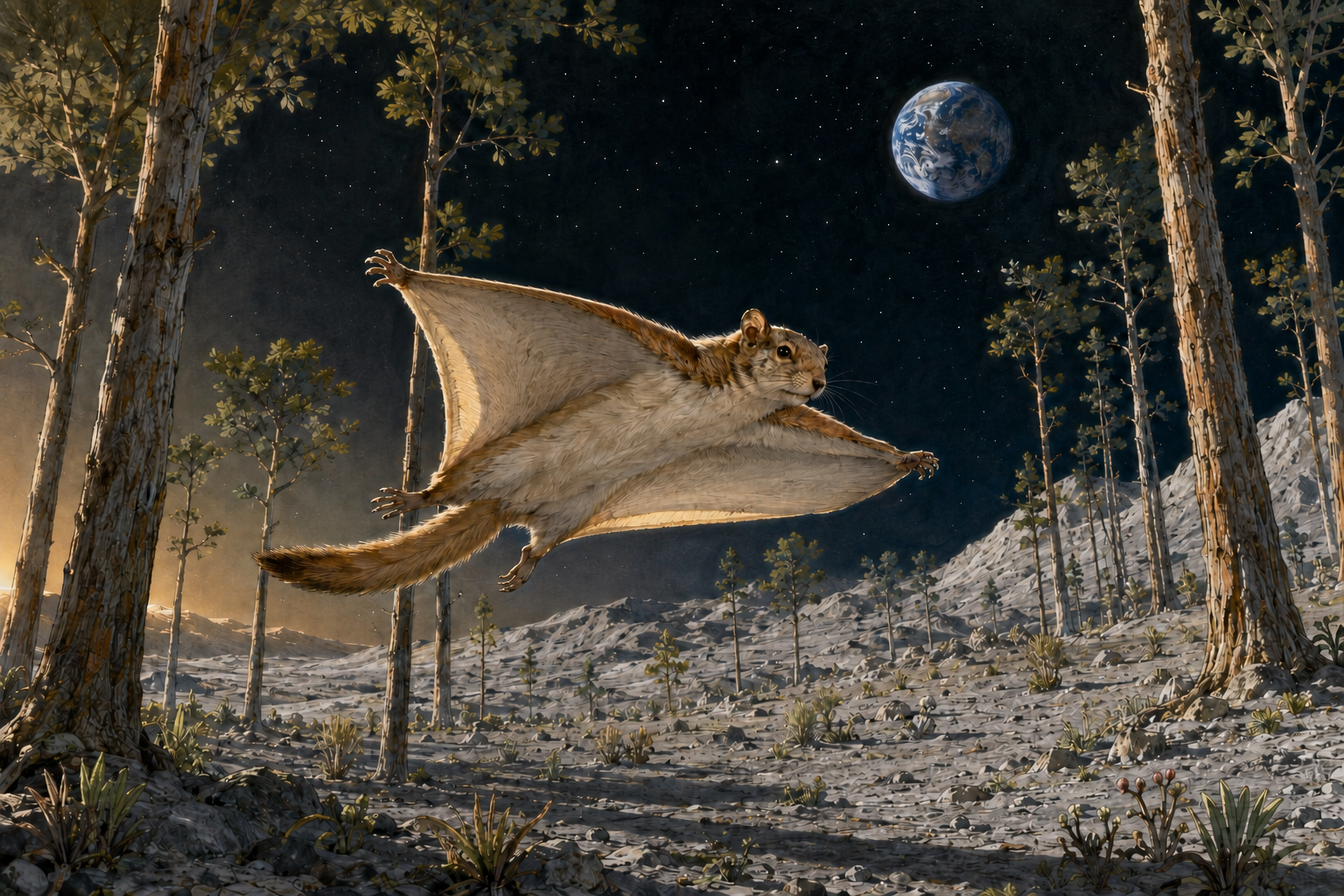
Just a squirrel, as far as anyone on the Moon is concerned.
The forest dies every sunset
Plants have a different problem. Fourteen days of uninterrupted sunlight sounds wonderful if your job is photosynthesis, but the following fourteen days do not. In the real airless lunar environment, surface temperatures near the equator can swing from about 127°C (260°F) in full sunlight to around -173°C (-280°F) in darkness. Our imaginary atmosphere and bodies of water would moderate those extremes, so I am not assuming that a terraformed lunar forest literally experiences those temperatures. But no atmosphere changes the underlying astronomical problem: the Sun still goes away for roughly two weeks.
A mature lunar ecosystem would therefore have had tens of millions of years to evolve around one overriding rhythm: store everything you can while the Sun is up.
During the long day, forests would probably become as productive as Earth forests in spring and summertime. Leaves unfold, flowers open, pollinators emerge, and plants pour energy into huge roots, tubers, trunks and other storage organs. Animals gorge themselves. Short-lived plants might germinate, reproduce and die within a single daylight period.
As the Sun approaches the horizon, the whole ecosystem begins shutting down. Some trees might drop their leaves; others might curl or insulate them. Delicate above-ground tissues could die back while roots and bulbs remain alive below the soil. Animals retreat into burrows, caves or insulated nests. Metabolic rates fall. Lakes might freeze at the surface even while liquid water survives underneath.
By the middle of the lunar night, an Earth visitor could walk through a forest and think something terrible had happened. Bare trunks stand over frozen ponds. There are no insects and no birdsong. Almost nothing moves. The landscape appears dead.
It isn't. Two weeks later, sunlight touches the upper branches and the forest begins to wake. Buds open. Animals emerge. Meltwater starts running. Within a few days, the same apparently dead landscape could be overwhelmingly green.
There might be no single "spring" in the Earth sense. Every lunar sunrise would be a kind of spring.
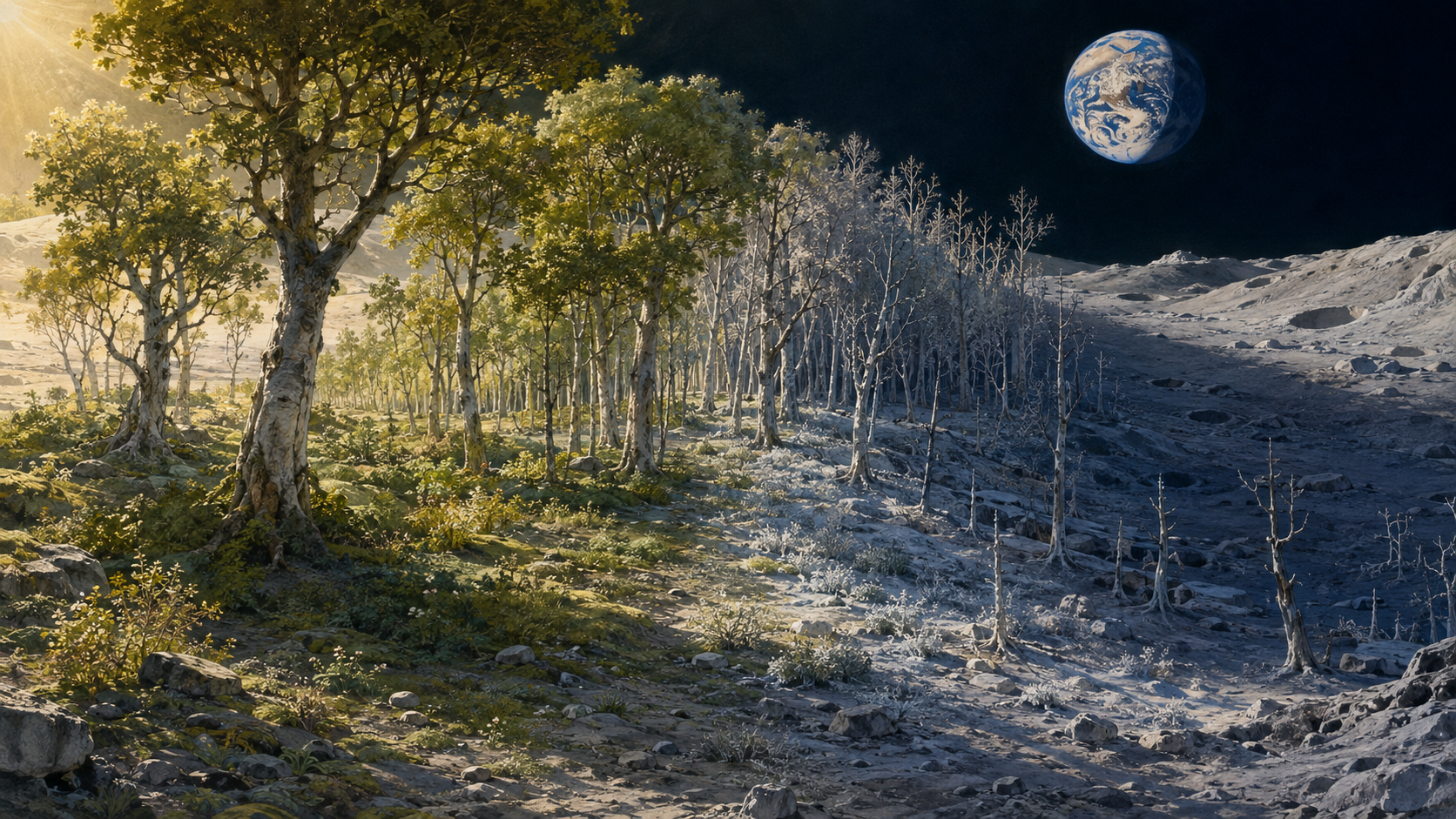
A forest caught at the terminator, halfway into its two-week night.
Or you could simply refuse to experience night
There is another solution to the Long Night: leave.
The boundary between day and night is called the terminator, and because a lunar solar day lasts about 29.5 Earth days, that boundary creeps around the Moon very slowly. This creates an ecological opportunity that doesn't really exist on Earth in the same way. An animal capable of sustained migration might not need to survive two weeks of darkness at all. It could follow the moving boundary of daylight.
Entire ecosystems could evolve around chasing twilight. Huge herbivore herds could migrate continuously around the Moon, keeping the setting Sun ahead of them. Predators follow the herbivores; scavengers follow the predators; flying animals drift overhead. Plants can't walk after them, but plants can make seeds, and perhaps some lunar grasses evolve seeds specifically adapted to travel with the herds, creating a moving wave of germination and grazing around the world.
Insects could emerge in waves. Migratory birds, or whatever 66 million years of low gravity has turned birds into, might spend much of their lives following the terminator. There could be animals that rarely experience true noon and others that almost never experience true night. Their entire evolutionary niche is sunset.
That is such a strange environment that it could produce equally strange senses and behaviors. Animals might navigate by the angle of the Sun with uncanny precision. Their internal biological clocks might track an entire lunar month. Mating, birth, metamorphosis and migration could all be synchronized to particular stages of the journey. Instead of thinking of an ecosystem as something inhabiting a particular forest or plain, you could have an ecosystem that is itself traveling perpetually around the world like a wave.
And then there are the poles
If the equatorial world is ruled by time, the poles are ruled by geography. Near the lunar poles, the Sun stays so low that a relatively small change in elevation can radically change how much illumination a location receives; NASA visualizations of the south pole show distant mountains throwing long shadows across the landscape while some deep crater floors remain permanently dark.
In our living Moon, a high ridge receiving unusually persistent sunlight might support plants that never evolved the extreme dormancy strategies of the great lunar forests. These could become some of the Moon's most productive ecosystems: dense, strange gardens clinging to illuminated highlands. Descend into a permanently shadowed crater, meanwhile, and photosynthesis becomes impossible.
That does not necessarily mean life becomes impossible. Earth already has ecosystems that function without sunlight. At hydrothermal vents and cold seeps, microorganisms use chemical energy rather than sunlight to produce organic matter through chemosynthesis, supporting larger communities of animals. Other deep-sea organisms ultimately depend on organic material falling down from sunlit waters above. A lunar shadow ecosystem might use some combination of the same strategies: chemosynthetic microbes where the geology permits it, fungi and decomposers feeding on imported organic material, and animals surviving on nutrients carried in from the light.
You could stand on a sunlit polar ridge covered in vegetation, look down into a crater that has not seen direct sunlight in millions of years, and know that an entirely different ecosystem exists in the darkness below.
The Moon would still look like the Moon
There is no particular reason our hypothetical terraformers need to cover every square kilometer in forest and ocean. Most of the lunar surface could remain gray, cratered and comparatively barren, with water and vegetation concentrated where geography and climate allow them to persist. Craters become ecological islands. Lava tubes become protected underground refuges. Green valleys collect around lakes and rivers while enormous stretches of highland remain stark and dry.
That isolation would create another evolutionary engine. Imagine two crater lakes colonized by the same ancestral bird 40 million years ago, after which the populations lose contact. In one crater, its descendants become nectar feeders. In another, they become terrestrial predators. Somewhere else, the same ancestral lineage eventually produces enormous soaring scavengers that barely need to flap their wings.
This is essentially island biogeography on a planetary scale. Every crater can become its own Galápagos.
The result wouldn't be one lunar ecosystem. It would be thousands of evolutionary experiments running in parallel, periodically reconnecting when climate changes or a species manages to cross the barren terrain between them. Some lineages might spread halfway around the Moon. Others could exist in a single crater and nowhere else.